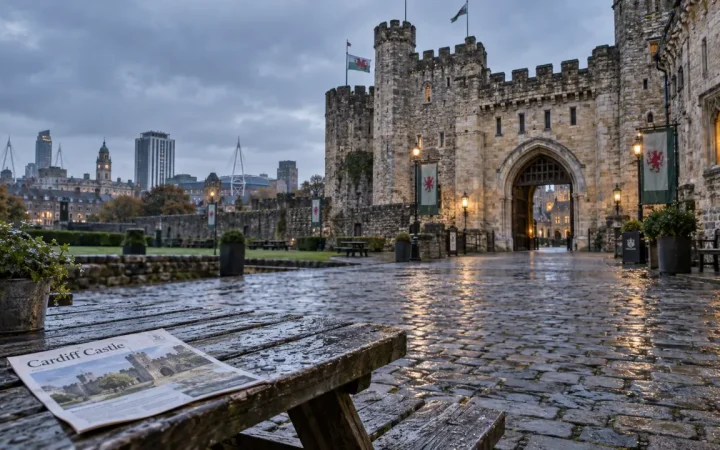
Cardiff Castle: Roman defences outside, Victorian splendour within
Cardiff Castle réunit fort romain, château normand et demeure victorienne. Explorez les pièces décorées, les shelters de guerre et le musée du soldat gallois.

Cardiff Castle brings together a Roman fort, a medieval stronghold and a Victorian Gothic Revival residence in the city centre. Its appeal lies in that contrast: defensive walls and the Norman Keep sit alongside elaborate interiors, while wartime shelters tell a different story beneath the walls. For a visit, the main decision is which parts to prioritise and whether to add a guided tour.
Cardiff Castle history: read the site in layers
The official Cardiff Castle website describes nearly 2,000 years of history within the site. Rather than treating it as one building from one period, look for successive changes in purpose: Roman defence, Norman control, aristocratic residence and civilian protection.

The historical account of Cardiff Castle places the first Roman fort probably around AD 55, with a later fort built in the middle of the 3rd century. The Norman castle followed a motte-and-bailey arrangement: a raised mound supporting a stronghold, with an enclosed courtyard below. Later stone construction strengthened its defensive role.
The Victorian transformation changed the emphasis from fortification to display. William Burges created Gothic Revival interiors for the Bute family, adding another architectural identity rather than simply restoring a medieval castle. This explains why the rooms and the keep can feel like separate attractions.
Think of the visit as an hourglass rather than a straight timeline. The same confined site channels very different centuries through a single space. At each stop, ask who needed protection, who controlled access and who was meant to be impressed. Those questions connect the Roman perimeter, the elevated keep, the decorated rooms and the wartime shelters more clearly than memorising dates alone.
Inside Cardiff Castle: choose your main interests
The Norman Keep and Victorian rooms
The keep and the interiors offer contrasting ways to understand the castle. Choose the keep for the defensive layout and the relationship between mound, walls and courtyard. Give the rooms more attention if architecture, decoration and the Victorian reinterpretation of medieval life are your main interests.
Visit Wales highlights Burges’ interiors and the Clock Tower, including the Summer Smoking Room. Its account describes 101 steps to the Clock Tower and city views from the tour. Treat the tower as a separate planning decision, not something to assume is automatically accessible during every visit.
Wartime shelters and the Firing Line museum
According to Visit Wales, the underground shelters provided space for around 2,000 people during the Second World War. They shift the focus from the castle’s owners to the civilians who depended on its walls for safety.
The same visitor guide describes Firing Line: Cardiff Castle Museum of the Welsh Soldier as covering over 300 years of service, representing two Welsh regiments: 1st The Queen’s Dragoon Guards and The Royal Welsh. It lists the museum as included with castle admission; confirm the current ticket inclusions before paying.
Cardiff Castle tours: match the format to your visit
A guided visit and independent exploration serve different needs. A House tour can help make sense of the decorated interiors, while an audio guide lets visitors pause and move at their own pace. Neither should be confused with the seasonal Clock Tower tour.
Visit Wales lists audio guides in 10 languages, a children’s version, portable guides and the Cardiff Castle app. Families may find the children’s interpretation a more useful starting point than trying to cover every room and historical period.
- For architecture: check House tour arrangements and which rooms the visit covers.
- For the Clock Tower: check seasonal availability, booking requirements and suitability of the steps.
- For independent exploration: confirm the audio-guide options offered when booking or arriving.
There is no need to make a short visit into a race. Pick a main interest first, then add another part of the site if time and access allow. Check tour departure times before deciding your order.
Tickets, Castle Key and a wider Cardiff outing
Use the official castle website for current admission prices, opening times, ticket conditions and tour availability. Check closing arrangements as well as opening time. Visitors with mobility or sensory requirements should confirm access for the particular rooms, towers and underground spaces they want to see, rather than assuming one arrangement applies throughout.
The official website describes the Castle Key scheme for eligible Cardiff residents or people who work in Cardiff, with free admission for 3 years. Check the current eligibility evidence, application conditions and exclusions before relying on it for a visit or event.
Visit Wales also identifies a café, gift shop and nearby Bute Park, which covers nearly 150 acres. The park offers a way to extend the outing without adding another indoor attraction.
For Cardiff Castle events, consult the official programme separately from ordinary admission. Concerts, outdoor cinema, banquets and historical activities feature in the visitor guide, but that does not establish what is running on any particular day. Confirm the event’s own entry arrangements before building a visit around it.